

Free PMF Playbook: How Top Startups Found Product-Market Fit
Product Market Fit Playbook
This Playbook will explain you the concept, how to measure it and the exact strategies used by Slack, Intercom, AirBnB, and more, to achieve it.
42%of startup failures are due to poor Product Market Fit, measure yours.
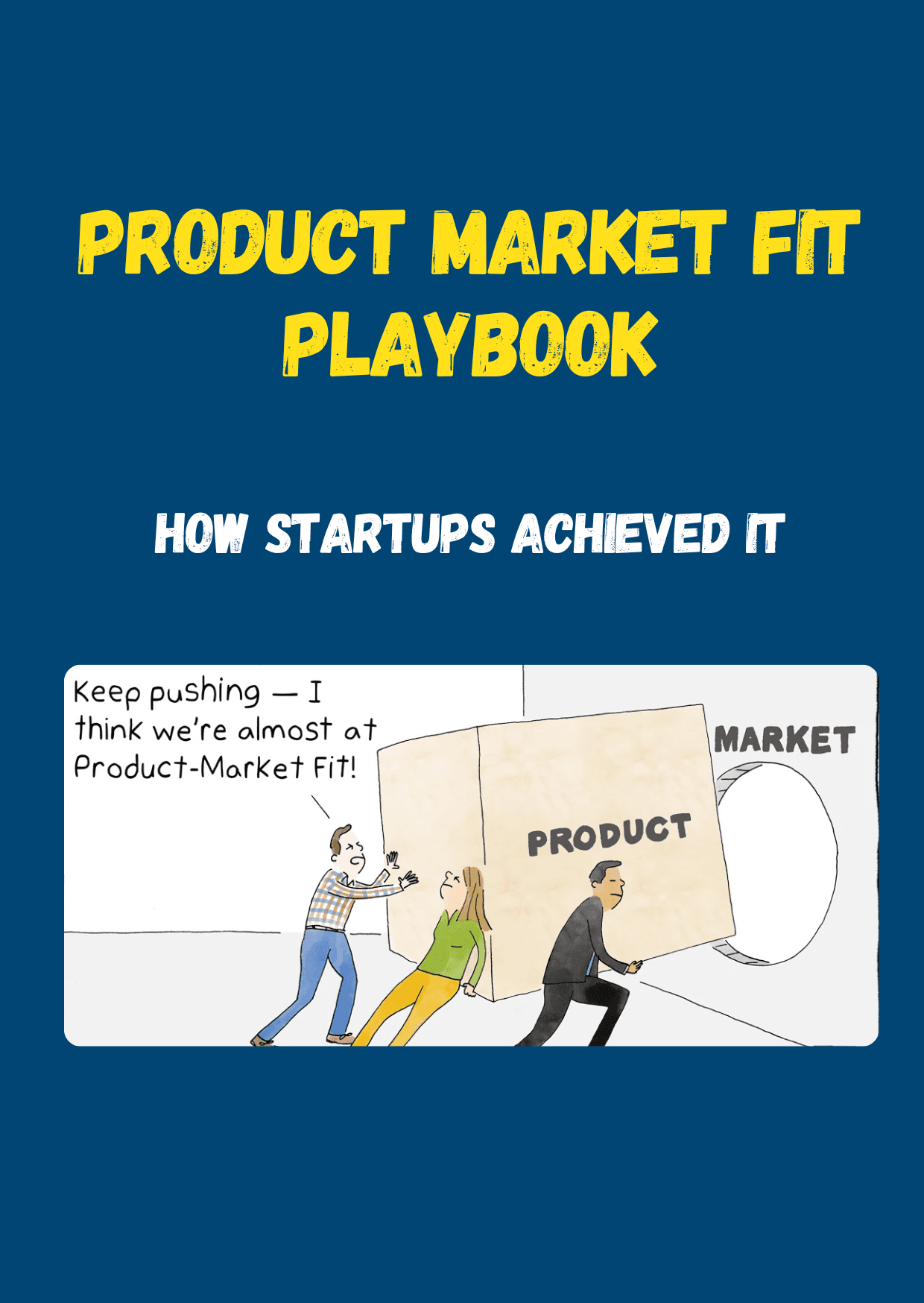
What's inside the playbook
A step-by-step guide to measuring, understanding, and improving your product market fit - based on real frameworks from the best startups.
The Sean Ellis 40% Test
The exact survey question and scoring methodology used to measure product market fit. Learn what the 40% benchmark means and how to interpret your results.
Superhuman's PMF Framework
How Rahul Vohra took Superhuman from 22% to 58% PMF. The 4-step process: segment to champions, understand what they love, build a split roadmap, repeat.
PMF Survey Questions
The complete set of product market fit survey questions to ask - the core "very disappointed" question plus follow-ups that reveal your ICP and value prop.
Segmentation Strategies
Why average feedback is misleading and how to segment survey results by user type, plan, company size, and use case to find your real champions.
Case Studies: Slack, Airbnb & More
How top startups measured and achieved product market fit. Real numbers, real strategies, real timelines - not theory.
When to Scale vs. When to Iterate
The signals that tell you to invest in growth versus the signals that tell you to keep improving the product. Based on PMF score ranges.
Product market fit survey tips
Common mistakes teams make when measuring PMF - and how to avoid them
Survey active users, not all signups
The biggest mistake teams make is surveying everyone who signed up. Users who never activated will say "not disappointed" because they never experienced your value. Survey users who have used your product at least twice in the past two weeks.
You need at least 40 responses
Sean Ellis recommends a minimum of 40 responses for directional accuracy. Below that, your PMF score will swing wildly with each new response. If you don't have 40 active users yet, focus on getting there before running the survey.
Segment your results - averages lie
A 42% PMF score might mean every segment is lukewarm, or it might mean enterprise users at 12% are dragging down free users at 78%. Segmented data tells you where you actually have PMF and where you don't.
Run it quarterly, not once
Product market fit is not a one-time measurement. Run the survey after major releases, quarterly, or whenever your user base changes significantly. Track the trend - a declining PMF score is an early warning of churn.
Read the qualitative answers
The "very disappointed" percentage is just the headline. The real gold is in the open-text follow-ups. What your champions say is the main benefit - use their exact words in your marketing. What they want improved - that's your roadmap.
Don't optimize for the number - optimize for the insight
The goal isn't to hack your way to 40%. It's to understand which users find your product indispensable and why. Then you can build for more users like them and position your product in their language.
Product market fit score benchmarks
What your PMF score means and what to do at each stage
Scale aggressively. Your product is a must-have for a clear segment. Invest in growth channels.
You've crossed the threshold. Optimize your positioning, expand to adjacent segments.
Segment to find your champions. Build for them specifically. Repeat the survey in 4-6 weeks.
Don't invest in growth yet. Talk to users, understand their jobs-to-be-done, and iterate fast.
Superhuman started at 22% and reached 58% in 3 quarters
Most products start below 40%. The playbook shows you the exact steps to improve.
The product market fit survey questions you need
Based on the Sean Ellis test and Superhuman's framework - these are the questions every PMF survey should include
“How would you feel if you could no longer use [PRODUCT]?”
The core PMF question. "Very disappointed" = must-have user.
“What type of people would most benefit from [PRODUCT]?”
Reveals your ideal customer profile from your champions' perspective.
“What is the main benefit you receive from [PRODUCT]?”
Your value proposition in real user language - use it in marketing.
“How can we improve [PRODUCT] for you?”
Your roadmap prioritization data. Build what champions want, fix what "somewhat disappointed" users are missing.
“What would you use as an alternative if [PRODUCT] didn't exist?”
Competitive intelligence. Shows your true competition from the user's perspective.
Ready to run your own PMF survey? Use one of our free templates:
Who is this playbook for
Early-Stage Founders
You're pre-PMF and need a clear framework to measure whether your product is working. This playbook gives you the exact survey to run and how to interpret the results.
Product Leaders
You need to track PMF across segments and releases. Learn how to set up ongoing PMF measurement and use it to drive roadmap decisions.
Growth Teams
You want to know if it's safe to invest in acquisition. The playbook shows you the PMF threshold you need before scaling spend.
Anyone Below 40%
You ran a PMF survey and scored below the benchmark. The playbook walks you through Superhuman's exact process for improving from 22% to 58%.
Frequently Asked Questions
What is a product market fit survey?
A product market fit survey measures how essential your product is to users. The most common method is the Sean Ellis test, which asks "How would you feel if you could no longer use this product?" If 40% or more say "very disappointed," you have product-market fit.
How do I measure product market fit?
Run a PMF survey with your active users (at least 40 responses from users who've experienced your core value). Calculate the percentage who said "very disappointed." Track this score over time as you iterate on the product.
What is a good product market fit score?
Above 40% is considered strong PMF (ready to scale). 25-40% means you're getting close - segment to find your champions. Below 25% means you should focus on product improvements before investing in growth.
Is the playbook really free?
Yes. Enter your email and we'll send it immediately. No credit card, no trial period, no upsell strings attached.
What makes this different from blog posts about PMF?
This is a step-by-step operational playbook, not a concept overview. It includes the exact survey questions, scoring methodology, segmentation framework, and improvement process with real case studies from Superhuman, Slack, and Airbnb.
More product playbooks
Step-by-step guides for every major product and retention challenge.
Product Strategy
How to Measure Product Market Fit
Learn how to measure product market fit using the Sean Ellis test, Superhuman framework, and survey-based scoring. Includes benchmarks, survey questions, and what to do at each score range.
Customer Loyalty
How to Improve NPS Score
Learn how to improve your Net Promoter Score with a step-by-step process - close the loop with detractors, act on passives, and turn promoters into advocates.
Retention
How to Reduce SaaS Churn
A step-by-step playbook for reducing SaaS churn - identify churn reasons with exit surveys, fix onboarding gaps, segment at-risk users, and build a retention system.
Onboarding
User Onboarding Best Practices
A step-by-step user onboarding playbook for SaaS - measure activation, identify drop-off with surveys, reduce time to first value, and build an onboarding that retains.
Product Strategy
How to Prioritize Product Features
A step-by-step playbook for feature prioritization - collect user feedback systematically, score features by impact and effort, and align your roadmap to your ICP.
Research
How to Do User Research
A practical user research playbook for product teams - when to use surveys vs. interviews, how to write unbiased questions, how to analyze results, and how to act on findings.
Retention
SaaS Customer Retention Strategies
Proven SaaS customer retention strategies - measure leading indicators, run proactive surveys, segment at-risk accounts, and build a systematic retention program.
Customer Experience
How to Improve Customer Satisfaction
Learn how to improve customer satisfaction with CSAT surveys, customer effort scoring, segmented analysis, and a systematic improvement cycle. Includes benchmarks and examples.
Customer Feedback
How to Collect Feedback from Customers
Learn the best ways to collect feedback from customers - in-app surveys, NPS, CSAT, exit surveys, and more. A practical guide for SaaS founders and product teams with templates and benchmarks.
Survey Best Practices
How to Increase Survey Response Rate
Learn how to increase survey response rate for NPS, CSAT, and PMF surveys. In-app vs email, timing, length, targeting - a practical guide for SaaS product teams.
Survey Best Practices
How to Analyze Survey Results
Learn how to analyze survey results for NPS, CSAT, CES, and PMF surveys. Segmentation, benchmarks, qualitative analysis, and how to turn scores into product decisions.
Product Strategy
How to Find Product Market Fit
How to find product market fit for your startup. The discovery process, signs you've achieved PMF, what to do at each stage, and how to recognise the 40% threshold before it shows up in revenue.
Product Strategy
How to Achieve Product Market Fit
How to achieve product market fit from pre-PMF to crossing the 40% threshold. The ICP narrowing strategy, iteration process, and what reaching PMF actually requires - step by step.
Customer Experience
How to Measure Customer Experience
Learn how to measure customer experience with NPS, CSAT, and CES surveys. Covers which metrics to use, when to trigger them, how to segment results, and how to track improvement over time.
Customer Experience
How to Measure Customer Satisfaction
Learn how to measure customer satisfaction with CSAT surveys. Covers when to trigger surveys, how to calculate your score, segmentation, benchmarks, and how to act on results.
Survey Best Practices
How to Write Survey Questions
Learn how to write good survey questions and questionnaires that get honest, useful answers. Covers question types, wording, leading questions, customer satisfaction surveys, research surveys, and common mistakes for NPS, CSAT, CES, and PMF.
Startup Strategy
How to Validate a Business Idea
Learn how to validate a business idea before you build - customer discovery surveys, 10-question interview framework, concept tests, and the signals that mean go vs pivot. For founders validating a startup idea.
Browse more templates
View all Templates