

Market Research Survey Software
Market Research Survey Templates & Questions
Six ready-to-use market research survey templates - from concept validation to pricing research.
Target audience discovery, competitor analysis, willingness to pay, brand perception, and market sizing - each template includes copy-ready questions.
Market research with segment context
Other tools
"Respondents say they'd pay $50/month."
Mapster Surveys
Founders · would pay $120/mo · "saves us 4 hours/week"
SMB managers · would pay $45/mo · "needs better integrations"
Individual contributors · would pay $20/mo · "price is the blocker"
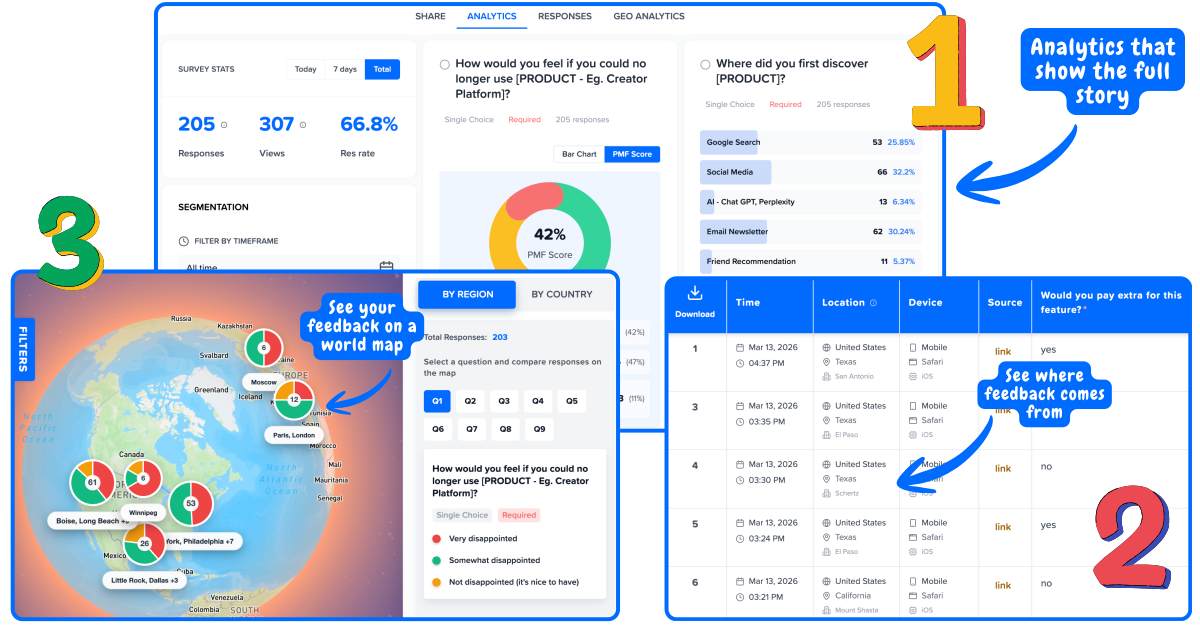
See which market segments responded, and what they actually said
Market Research Survey Templates
Six market research survey templates covering every stage - from pre-build concept validation to post-launch pricing analysis. Each includes copy-ready questions. Keep surveys to 3–5 questions for the best response rates on cold audiences.
Target Audience Discovery
- 1.What best describes your role? (Founder, VP, Manager, IC)
- 2.What problem are you currently trying to solve in this area?
- 3.How do you currently handle this today?
Before product development - validate your ICP
Concept Validation
- 1.If a product solved [X], how interested would you be? (1–5)
- 2.What would be the most important feature of an ideal solution?
- 3.What would make you switch from your current approach?
Pre-build - test demand before writing code
Competitor Analysis
- 1.What tools do you currently use to solve this problem?
- 2.What do you like most about your current solution?
- 3.What is the biggest gap or frustration with existing options?
Ongoing - understand the competitive landscape
Pricing Research
- 1.What would you expect to pay per month for a solution like this?
- 2.At what price would this feel too expensive to consider?
- 3.What pricing model would you prefer? (monthly, annual, per-seat)
Pre-pricing - find willingness to pay by segment
Brand Perception Survey
- 1.How would you describe our brand in three words?
- 2.How do we compare to [Competitor] in terms of trust and quality?
- 3.What would make you trust a new product in this category?
Post-launch - validate brand positioning and messaging
Market Sizing Survey
- 1.How often do you experience this problem? (daily, weekly, monthly)
- 2.How many people on your team deal with this issue?
- 3.How much would solving this problem be worth to your business per year?
Early-stage - size TAM and estimate value per customer
Market Research Survey Questions
The questions you ask determine what you can act on. These market survey questions are organized by goal - use them to build a company market research questionnaire that moves from demographics to pricing in one flow.
Demographics & Segmentation
- •What best describes your role? (Founder/CEO, VP/Director, Manager, Individual Contributor)
- •How large is your company? (1–10, 11–50, 51–200, 201+)
- •What industry are you in, and how long have you been in it?
Problem & Pain Point
- •What problem are you currently trying to solve in this area?
- •How do you handle this problem today, and how satisfied are you with that approach?
- •How much time or money does this problem cost you per month?
Solution & Concept Validation
- •If a product could solve [X], how interested would you be on a scale of 1–5?
- •What would be the single most important feature of an ideal solution?
- •What would convince you to switch from your current approach?
Pricing & Willingness to Pay
- •What would you expect to pay per month for a solution like this?
- •At what monthly price would this feel too expensive to consider?
- •What pricing model fits your budget best - monthly, annual, or per-seat?
Ready to run these surveys? See concept testing & validation surveys →
How to run a market research survey
Most market research surveys fail before they launch - because the objective is wrong, the questions are leading, or the audience is too broad. Follow this sequence to avoid the most common mistakes.
Define the decision this survey needs to inform
Start with the output, not the questions. Are you deciding which customer segment to target? Whether to build a feature? What price to charge? A market research survey without a clear decision to inform produces interesting data that nobody acts on.
Choose your survey type
Exploratory surveys use open-ended questions to discover unknowns - use these before you have a hypothesis. Validation surveys test a specific hypothesis with rating scales - use these once you have a concept to test. Pricing surveys measure willingness to pay with Van Westendorp or direct WTP questions - use these before you set pricing.
Write 5-10 questions, one idea per question
Every question should map directly to the decision you defined in step 1. Cut anything that is nice to know but not need to know. Avoid double-barreled questions ('How satisfied are you with price and quality?'), leading questions ('Don't you agree that X is a problem?'), and vague scales without anchors.
Recruit respondents who match your ICP - not just anyone
Pre-product: recruit from LinkedIn communities, Slack groups, Reddit, and competitor review sites (G2, Capterra). Post-product: send to existing users plus a non-user control group. For B2B research, aim for at least 50 responses from your target segment before drawing conclusions. Cold outreach with a $10 gift card typically gets 15-25% response rates.
Analyze by segment, never by average
An average WTP of $50 across decision-makers and individual contributors hides a $120 segment and a $20 segment - which are completely different businesses. Cross-tabulate every key metric by role, company size, and current behavior. Look for the 3-5 patterns that appear across at least 20% of responses before building any hypothesis around them.
Segment Market Research Data
See What Each Buyer Type Actually Wants
An average willingness-to-pay figure hides the real pricing opportunity. Decision-makers and individual contributors have completely different price sensitivities - and different objections.
Customer research, market research, and product research surveys
The three terms overlap but feed different decisions. Here is when to use each one.
Customer Research Survey
- →Sent to existing or previously contacted customers
- →Focuses on behavior, pain, and motivation
- →Runs post-onboarding or at lifecycle moments
- →Goal: improve retention and positioning
- →Best question: “What made you decide to try this?”
Market Research Survey
- →Sent to a market segment, including non-customers
- →Focuses on sizing opportunity and validating demand
- →Runs pre-product or when entering a new segment
- →Goal: decide what to build and who to build it for
- →Best question: “How do you handle this problem today?”
You are here
Product Research Survey
- →Sent to active users interacting with the product
- →Focuses on feature gaps, usability, and roadmap priority
- →Runs continuously as new features ship
- →Goal: inform what to build next and what to cut
- →Best question: “What is the biggest thing missing?”
When the distinction matters: Pre-product with cold prospects: market research. Post-launch with your user base to understand churn or onboarding: customer research. Deciding what to build next with active users: product research. All three use the same survey mechanics - the difference is who you ask, when you ask, and what decision the data feeds.
Market research survey FAQ
Common questions about planning a market research survey, writing effective questions, recruiting respondents, and analyzing results.