

The Recovery Playbook
How to Turn NPS Detractors into Promoters
The 24-hour window, the 6-step playbook, the outreach templates, and the Slack-alert workflow that makes it operational.
Recovered detractors often become more loyal than customers who never complained. The hard part is the operational handoff, not the conversation.
Why detractor recovery is the highest-ROI work in CS
Three numbers that explain the math.
24 hrs
The window where reply rates stay above 50%. After a week, replies drop below 15%.
5-7x
Cost of replacing churn through new acquisition vs the cost of recovering a detractor.
>100%
Service recovery paradox: well-recovered customers often score higher than those who never complained.
The window
The 24-hour rule
The single most important variable in detractor recovery is time to first response. A user who hears from your team the same day they submitted a 3 out of 10 feels heard. A user who hears nothing for a week has already started looking at alternatives.
Reply rates degrade fast outside the window. Within 24 hours: above 50%. By day 3: around 30%. After a week: 15% or lower. The conversation that could have saved the account no longer happens.
What 24-hour response requires
- Real-time notifications, not a weekly digest. Your CS team needs to know the moment a detractor response lands.
- User identity attached to the response. A score without a name is unactionable.
- The open-text reason in the alert, so the responder does not need to chase context before reaching out.
- A clear owner. Either a specific CSM by account, or a rotating CS lead who handles detractor outreach.
The 6-step detractor recovery playbook
The full sequence from alert to resolution. Each step has a specific output the next step depends on.
Acknowledge within 24 hours
Send a personal email from a real person (not a noreply address). Subject line: "Saw your survey response, want to make this right." Reference the score and the open-text answer specifically. Do not pitch, do not defend, do not template it so heavily that it reads as automated.
Output: Reply rate above 50%.
Ask one specific follow-up
Vague follow-ups ("how can we improve?") get vague answers. Specific follow-ups ("You mentioned support was slow on the billing issue last week. Was it the time to first response, the time to resolution, or both?") get specific answers you can act on.
Output: A concrete root cause, not a generic complaint.
Listen all the way through
Resist the urge to defend the product or pivot to a workaround. The user is telling you exactly why they would not recommend you. Capture it word for word, then ask one or two clarifying questions. The goal is to understand, not to convince.
Output: A clear, documented problem statement.
Offer a concrete fix
Match the fix to the root cause. Product gap: confirm the feature is on the roadmap with a target. Pricing complaint: offer a credit or a downgrade. Support friction: escalate to a senior agent. Onboarding confusion: book a free training session. Avoid vague promises like "we will look into it."
Output: A specific commitment with a date.
Close the loop in public
When the fix ships, tell the user directly and announce it in your changelog or release notes. Reference the feedback that triggered it (anonymised if needed). Other detractors who never wrote in see that the loop closes, which lifts trust across the entire user base.
Output: A visible track record of acting on feedback.
Track the re-score
When the next NPS cycle comes around, look at whether the recovered detractor re-scored higher. Aim for at least a 3-point lift on the 0 to 10 scale. If they re-score in the same range, the fix did not address the root cause. If they re-score as a promoter, you have a case study candidate.
Output: Hard data on which recovery efforts paid off.
Detractor outreach templates
Two templates that work: the personal email and the Slack alert that triggers it.
Template 1: The personal email
Subject: Saw your survey response, want to make this right
From: [Your name] at [Company]
Hi [First name],
I saw your NPS response yesterday, you gave us a [score] and mentioned [specific thing from open-text]. Thanks for being honest. I would rather hear it directly than wonder why you stopped using us.
Quick question: [one specific clarifying question tied to the open-text comment].
If you have 15 minutes this week, I would like to talk. Here is my calendar: [link]. Or just reply to this email, whatever works.
[Your name]
[Title], [Company]
Why this works: subject line acknowledges the specific event, body references the actual score and comment, the question is specific, the next step is low-friction.
Template 2: The Slack alert
🚨 NPS Detractor: Marc Klein scored 3 / 10
Plan: Pro ($49/mo)
Location: Berlin, DE
Signed up: 11 months ago
Last activity: 2 days ago
Reason: “Support was slow on the last billing issue”
Owner: @sarah
[Reach Out] [Open Profile] [Mark Handled]
Everything the responder needs to act inside the 24-hour window: name, context, reason, and owner. No dashboard lookup required.
Why most teams cannot run this playbook
The playbook is straightforward. The blocker is operational: most NPS tools anonymise the response.
Anonymous NPS (most tools)
Score: 3
Reason: support was slow
Timestamp: 2026-05-22 14:33
Email: (not collected)
Cannot reach out. Cannot acknowledge. Cannot recover. The detractor sits in your dashboard as a percentage. The 24-hour window opens and closes with no action possible.
Identified NPS (Mapster)
User: Marc Klein
Plan: Pro ($49/mo), 11 months
Location: Berlin, DE
Last ticket: billing, 4 days ago
Score: 3 “support was slow”
CS reaches Marc by name within the hour, references the exact ticket, asks one specific question, and starts the recovery sequence. The playbook is operational.
Route detractors into the recovery flow automatically
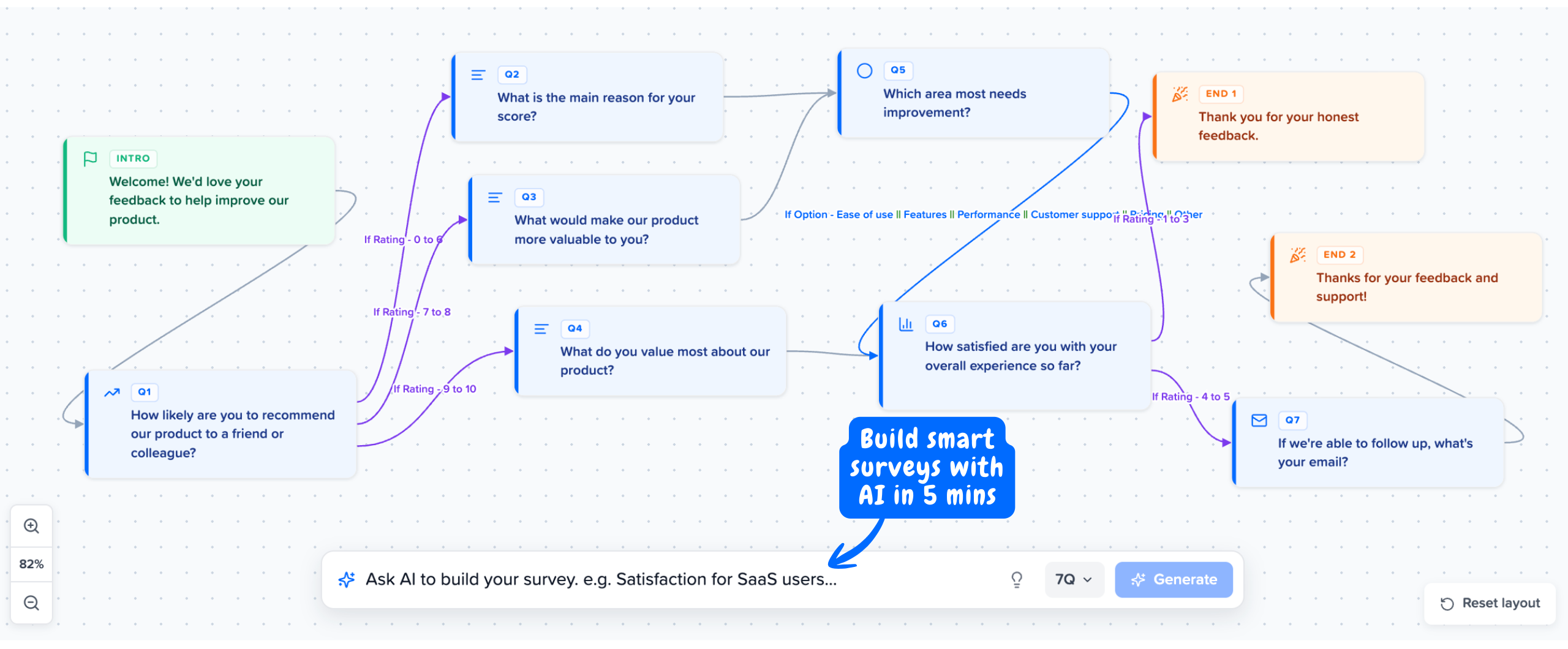
Mapster builds the NPS survey with branching logic in 2 minutes. Detractors get the open-text follow-up that feeds the Slack alert. Promoters get a different path. The recovery sequence is wired into the survey itself.
No credit card required
Common detractor recovery mistakes
Five missteps that turn recovery attempts into churn accelerators.
Responding from noreply@
A noreply address signals automated, defensive, and uninterested. Send from a real person at a real address. The relational reset begins with the from line.
Defending the product before listening
If the user says "the billing flow is broken," do not respond with "actually that is how it works." Even if they are wrong, the recovery conversation cannot start until they feel heard.
Offering generic discounts as the first move
A discount before understanding the root cause says you would rather buy them off than fix the underlying issue. Discounts can be part of the resolution, but not the opener.
Promising fixes you do not control
If the fix depends on product roadmap, do not promise a date you cannot deliver. Say "this is on the roadmap, I will update you when the engineering team commits to a quarter." Then actually update.
Skipping the loop close
If you fix the thing and never tell the user, the recovery is wasted. They assume you did nothing. The closed loop ("we shipped X because you told us Y") is what converts a detractor into a promoter.
Get a Slack alert the moment a detractor responds
Every NPS response linked to the user. Detractors trigger a real-time Slack alert with the score, the reason, and the user profile. Reach out within the recovery window. Free plan available, Pro from $8/mo.
Run NPS with Detractor AlertsNo credit card required