

NPS Definitions & Score Ranges
NPS Promoters, Passives, and Detractors
The three NPS categories explained: score ranges, the formula, what each segment means, and what to actually do with them.
The NPS scale at a glance
Eleven points (0 to 10), three categories. The split is fixed and standardised across every NPS implementation.
Detractors
0 to 6 (7 points)
Passives
7 to 8 (2 points)
Promoters
9 to 10 (2 points)
Detractors cover seven points of the scale. Promoters cover only two. This is intentional. The bar for being a promoter is high because a real recommendation is a high bar.
What is an NPS detractor?
A detractor is any respondent who answers 0 through 6 on the NPS question. The detractor range covers seven of the eleven scale points. Any score below 7 is a detractor, regardless of how close to passing it is.
Detractors are unhappy customers at risk of churning. Bain research found that detractors are roughly 4 times more likely to churn within 12 months than promoters and account for the bulk of negative word of mouth. A growing detractor count is the strongest leading indicator of revenue decline that does not show up in retention dashboards yet.
What detractors signal
- Active dissatisfaction with the product, support, pricing, or experience.
- High churn risk within the next 6 to 12 months.
- Negative word of mouth that suppresses growth (referrals, reviews, social proof).
- Often clustered in a specific segment (a plan tier, a region, a use case) that is being underserved.
What to do with detractors
- 1. Reach out within 24 hours. The recovery window is tight. A detractor who hears from your team within a day is recoverable. One who hears nothing is a churn statistic.
- 2. Ask why. Pair the rating with an open-text follow-up. The qualitative answer is where the actionable signal lives.
- 3. Segment to find the pattern. One detractor is noise. Twenty detractors clustered on the Pro plan in the EU is a fixable problem.
- 4. Close the loop. Tell them what you changed. Recovered detractors often become your most loyal customers.
The full playbook with outreach templates and the Slack-alert workflow: how to turn NPS detractors into promoters →
What is an NPS passive?
A passive is any respondent who scores 7 or 8. Passives are satisfied but unenthusiastic. They like your product enough not to complain and not enough to recommend it.
Passives are excluded from the NPS formula entirely. They count toward the total response pool used to calculate percentages, but their scores do not move the final number up or down. This is by design. Reichheld’s original Bain research found that only 9s and 10s reliably predict positive word of mouth, and only 0 through 6 reliably predict negative behaviour. The 7 to 8 zone does not predict either, so it is excluded.
What passives signal
- Satisfaction without commitment. The product works, but nothing stands out.
- Vulnerable to competitor switching. Passives have low switching cost in their head.
- Often a specific feature, integration, or pricing tier away from becoming a promoter.
- The largest single lever for raising your NPS score. Promoting a passive lifts the score on both sides of the formula.
What to do with passives
- 1. Ask what would make it a 9 or 10. Passives know exactly what is missing. The open-text follow-up to a 7 or 8 is the highest-signal qualitative feedback you will get.
- 2. Look for clusters. If 60% of passives mention the same missing feature, that feature is your single biggest NPS lever.
- 3. Avoid begging. Do not ask them for reviews or referrals. They will say no, and you will damage the relationship. Save that for promoters.
What is an NPS promoter?
A promoter is any respondent who scores 9 or 10. Only 9s and 10s count. A 7 or 8 is not a promoter, no matter how positive the open-text comment looks.
Promoters are loyal enthusiasts who actively recommend your product. They drive the bulk of referral growth, write positive reviews, and provide the social proof that converts new prospects. Bain research found that promoters typically have 2 to 3 times the lifetime value of detractors and account for over 80% of positive word of mouth.
What promoters signal
- Active enthusiasm and willingness to recommend the product publicly.
- Lower churn risk and higher lifetime value than passives or detractors.
- Source of organic referrals, reviews, and case study material.
- A growing promoter percentage is a strong leading indicator of organic growth.
What to do with promoters
- 1. Ask for a review or referral. Strike while they are warm. A promoter who scored you a 10 yesterday is more likely to act than one you ask a month later.
- 2. Recruit for case studies. Promoters are your best case study candidates. The story writes itself.
- 3. Listen for what they value. Promoter open-text answers tell you what you are doing right. Double down on those things in your marketing copy.
- 4. Do not ignore them. Promoter scores are not just a vanity metric. Quiet promoters churn too when the product stops delivering on what made them score 10 in the first place.
The NPS formula
Subtract one percentage from another. That is the entire calculation.
NPS = % Promoters − % Detractors
Result is a number between -100 and +100. Passives count toward the total response pool but not toward either percentage in the formula.
Worked example
100 responses total.
45 score 9 or 10 → 45% promoters.
30 score 7 or 8 → 30% passives (excluded from formula).
25 score 0 to 6 → 25% detractors.
NPS = 45 − 25 = +20
Skip the math: free NPS calculator takes your promoter / passive / detractor counts and returns the score.
Knowing your detractor count is not the same as knowing your detractors
The hard part of NPS is not the math. It is doing something with the result. Most tools leave you with anonymous percentages.
Anonymous NPS (Google Forms, generic tools)
25% Detractors
30% Passives
45% Promoters
NPS: +20
You have a score. You do not know which users are detractors. Reaching out is impossible. The score sits in a dashboard and does nothing.
Mapster NPS (user-linked)
Detractor: Marc Klein, Pro plan, Berlin, score 3
Passive: Sarah Wong, Free plan, Sydney, score 8
Promoter: Alex Rivera, Pro plan, Toronto, score 10
NPS: +20 (same score, actionable data)
Same score. Now CS can reach Marc within the hour, ask Sarah what is missing on the free plan, and queue Alex for a case study.
Route detractors and promoters down different paths
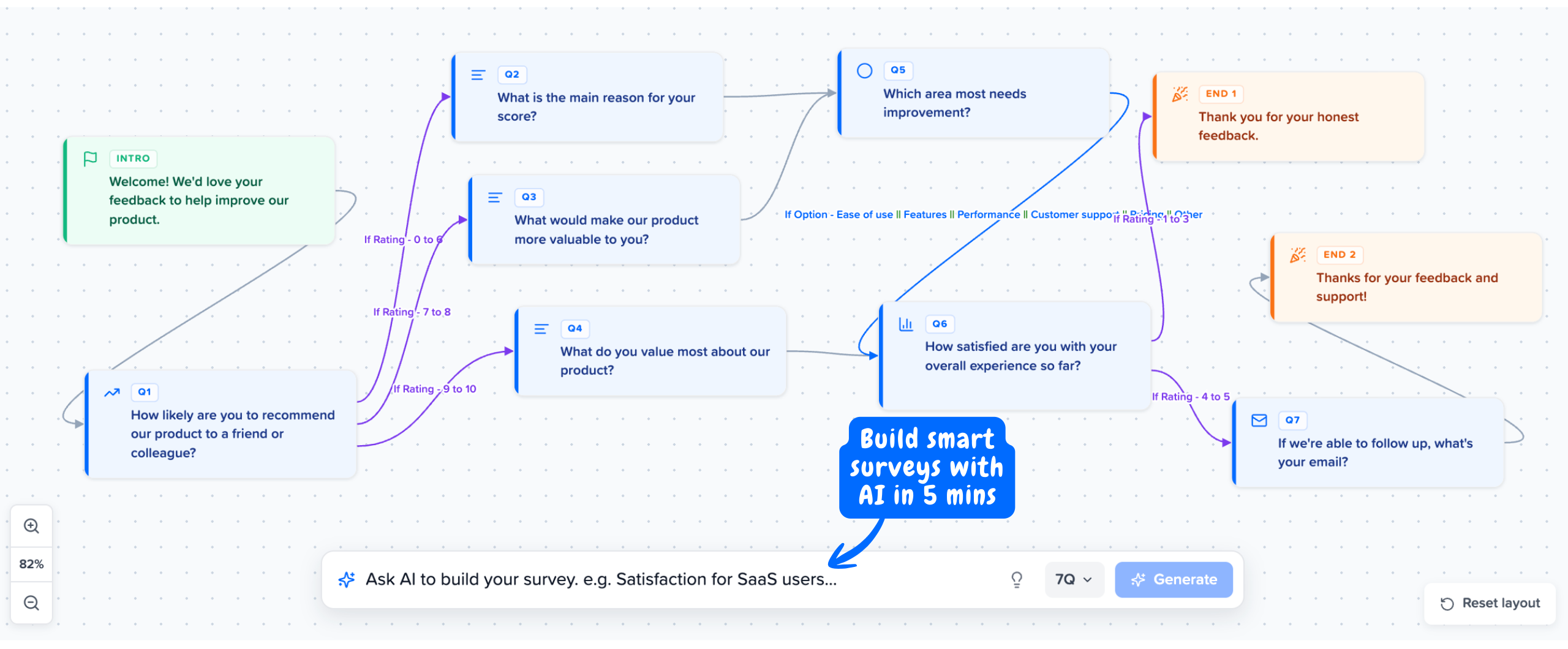
Mapster builds the NPS survey with branching logic in 2 minutes. Detractors get the open-text follow-up. Promoters get the review prompt. Passives get the gap question. One survey, three paths.
No credit card required
Common mistakes with promoter, passive, and detractor categories
Five misreadings that quietly invalidate NPS results.
Counting 7s and 8s as promoters
Only 9s and 10s count. A 7 or 8 is a passive, no matter how positive the open-text answer reads. Lumping them in inflates your score and hides the gap between satisfaction and advocacy.
Ignoring passives because they do not count in the formula
Passives are excluded from the formula, not from your attention. They are the largest pool of upside. Moving a passive to promoter lifts the score on both sides of the equation.
Treating 6 as a borderline detractor
A 6 is a full detractor. The NPS framework does not have soft detractors. If the cutoff troubles you, send a CES survey on top to measure friction at a finer grain instead of bending the NPS categorisation.
Calculating NPS from a tiny sample and reporting it as one number
A score from 20 responses is noise. Wait until you have at least 100 responses per segment you want to compare. A single overall score from 200 responses can be misleading if 80% came from one plan tier.
Showing the same NPS survey to every user every quarter
Survey fatigue ruins response rates. Suppress for 90 days after a user has responded. Sample subsets if your user base is large. Quality of response matters more than quantity.
Run an NPS survey where every promoter, passive, and detractor has a name
Automatic scoring, user-linked responses, segmentation by plan and role, in-app widget for 20 to 40% response rates. Free plan available, Pro from $8/mo.
Try Mapster NPS FreeNo credit card required