

Built for SaaS teams
Customer Feedback Tool for SaaS
Generic survey tools were not built for SaaS. They collect responses without linking them to user accounts, plan tiers, or lifecycle stage.
Mapster delivers NPS, CSAT, PMF, and exit surveys in-product - triggered by what users do, not a fixed schedule - so every score is tied to a real user you can act on. The user feedback SaaS teams actually use to reduce churn and improve retention.
Why generic survey tools fail SaaS teams
Tools designed for generic feedback collection miss three things every SaaS team needs.
Responses without context
A 7 on your NPS survey means nothing without knowing the user's plan, cohort, or feature usage. Generic tools give you a number. SaaS feedback tools give you a user.
Email delivery into the void
Email NPS surveys reach users days after their last session - in a generic inbox context, not inside your product. Response rates average 5-15% and skew toward your most engaged users, hiding churn risk.
Wrong metrics for SaaS
SaaS teams need NPS, CSAT, CES, and PMF - each measuring a different stage of the lifecycle. Generic survey builders give you a blank form. Mapster gives you the right question at the right moment.
Looking for a full tool-by-tool comparison? The 9 categories of SaaS feedback tools compared →
The 5 feedback moments every SaaS team needs
Each stage of the SaaS user lifecycle requires a different survey. Sending the wrong one at the wrong time wastes responses and misleads your team.
PMF Survey
Trigger: 30 days after first value moment"How would you feel if you could no longer use this product?"
Validates product-market fit before you invest in growth. The Sean Ellis 40% benchmark tells you whether your core product is ready to scale.
Learn moreOnboarding CSAT
Trigger: After completing key onboarding steps"How satisfied are you with the setup process?"
Onboarding friction is the biggest driver of month-1 churn. CSAT after onboarding catches problems before they become cancellations.
Learn moreNPS Survey
Trigger: Every 90 days, after product value experienced"How likely are you to recommend this product to a friend or colleague?"
Your quarterly health check. NPS tracks overall loyalty and surfaces detractors before they churn. Segment by plan to see where loyalty is weakest.
Learn moreCES Survey
Trigger: After support interactions, complex workflows"How easy was it to accomplish your goal?"
High effort = high churn risk. CES after support tickets and feature completions identifies friction in workflows before users give up.
Learn moreExit Survey
Trigger: When user cancels or downgrades"What is the main reason you are leaving?"
Your most valuable feedback comes from users who left. Exit surveys reveal pricing objections, missing features, and competitive losses - and build a win-back list.
Learn moreIn-product surveys vs email surveys for SaaS
Where and when you deliver a survey determines how useful the responses are. For SaaS, in-product wins on every metric that matters.
Email surveys
- -5-15% average response rate
- -Reaches users days after their last session
- -Generic inbox context - no product memory
- -Skews toward your most engaged users
- -Hides churn risk in the silent majority
- -Blocked by unsubscribes and spam filters
In-product surveys
- 20-40% average response rate
- Delivered at the moment of engagement
- Product context makes responses more accurate
- Reaches all active users equally
- Triggers based on behavior, not a calendar
- Responses linked to real user accounts
What good SaaS feedback tool does
Five capabilities that separate dedicated feedback SaaS platforms from generic survey builders.
Behavioral triggers
Survey users based on what they did - completed onboarding, hit a usage milestone, opened a feature - not on a fixed schedule. Behavioral triggers double response rates and cut irrelevant responses.
User attribute segmentation
Filter every survey result by plan tier, cohort, company size, or feature usage. A 38% NPS from free users and a 72% NPS from paid users are two completely different signals.
Native SaaS metrics
NPS, CSAT, CES, and PMF built in - not a blank form you configure from scratch. Each metric has a validated question format, scale, and follow-up. No setup required.
Qualitative follow-ups
Every score is a number. The follow-up open text is where you learn why. Good SaaS feedback tools pair every rating question with an optional follow-up that captures reasoning.
Score tracking over time
A single NPS score is a snapshot. Trend data over rolling quarters tells you whether product changes are improving loyalty or eroding it. Track scores by cohort and see the delta.
Slack and CRM routing
Route NPS detractors to your CS team in Slack the moment they submit. Send PMF responses to your Notion product board. Scores that stay in a dashboard rarely get acted on.
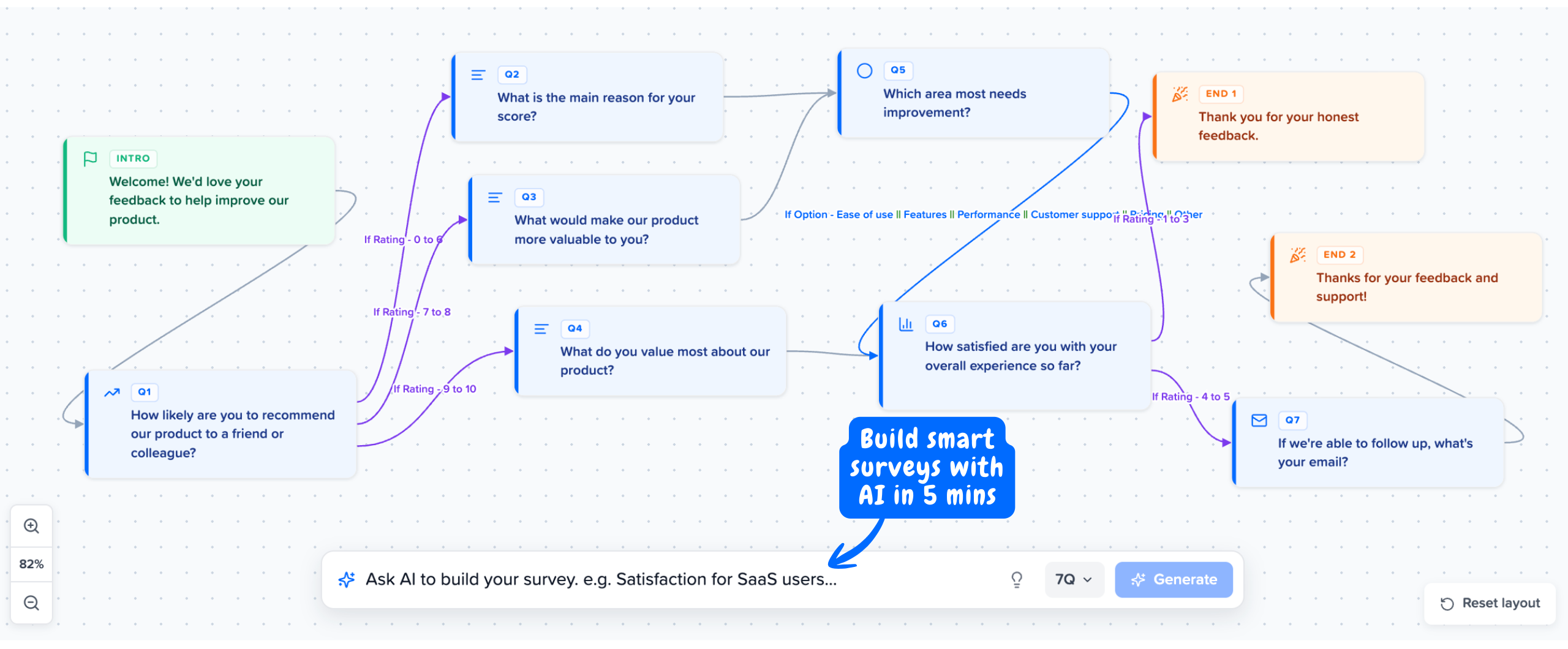
Build SaaS feedback surveys with branching logic in 2 minutes
Describe the survey you want. Mapster generates the questions, picks the right scale, and routes detractors, passives, and promoters down different paths. Built by AI, fully editable.
No credit card required
Every SaaS feedback metric in one platform
Mapster supports all four core SaaS feedback metrics natively. No plugins, no custom configuration - run the right survey at the right moment.
When to run
Quarterly, after value is experienced
Overall loyalty and likelihood to recommend. Segments users into Promoters (9-10), Passives (7-8), and Detractors (0-6). Your top-line health metric.
See NPS toolWhen to run
Post-onboarding, post-support, post-release
Satisfaction at a specific touchpoint. Measures whether a single interaction met user expectations. High NPS + low onboarding CSAT = churn risk in month 1.
See CSAT toolWhen to run
After high-effort interactions
How easy was the interaction? High effort predicts churn better than low satisfaction. Use CES after support tickets and complex workflows to find friction before it compounds.
See CES toolWhen to run
30+ days after first value moment, repeated quarterly
The Sean Ellis test: how disappointed would users be if your product disappeared? 40%+ 'very disappointed' = product-market fit. The only metric that tells you if you're ready to scale.
See PMF toolSaaS benchmarks
SaaS feedback benchmarks: what good looks like
The numbers SaaS teams should compare themselves against. Always segment by stage and plan tier before declaring a score “good.”
What is a good NPS score for SaaS?
For B2B SaaS, a positive NPS is the floor. Above 30 is good, above 50 is excellent, above 70 is world-class. Most B2B SaaS companies average between +20 and +50 depending on stage. Early-stage SaaS benchmarks at +20 to +45, mid-market at +30 to +50, and enterprise at +20 to +35. A single overall score is misleading without segmenting by plan tier, role, or cohort.
Below 0
Critical
0 to 30
Needs work
30 to 50
Excellent
50+
World-class
Deep dive: NPS benchmarks by industry and stage →
What is a good CSAT score for SaaS?
For SaaS, CSAT above 80% is good and above 90% is excellent on the standard 1-to-5 scale (CSAT = % of 4 and 5 ratings out of total). B2B SaaS support CSAT typically lands at 85 to 92%. Onboarding CSAT runs lower, often 75 to 85% because new users have less context. A drop in onboarding CSAT below 75% is one of the strongest early churn signals. Track CSAT per touchpoint, not as a single average.
Below 60%
Critical
60 to 79%
Needs work
80 to 89%
Good
90%+
Excellent
Deep dive: CSAT benchmarks by industry →
What is a good CES score for SaaS?
On the standard 1-to-7 CES scale, above 5.5 is good and above 6.0 is excellent. B2B SaaS support typically benchmarks at 5.4 to 5.8, onboarding at 5.2 to 5.6. CES is the strongest churn predictor for SaaS support interactions: Gartner found 96% of high-effort customers become disloyal. Run CES per interaction type, not as a blended average.
Deep dive: CES benchmarks by industry and stage →
What is the typical SaaS churn rate benchmark?
B2B SaaS monthly churn benchmarks at 1 to 2% (12 to 24% annual). B2C SaaS runs higher at 5 to 7% monthly. Enterprise SaaS churn (annual contracts over $50k) typically lands below 1% monthly, often around 0.5%. SMB-focused SaaS routinely sees 3 to 5% monthly. A churn rate above benchmark for your segment is a feedback problem, not just a sales problem. CES and NPS detractor follow-up are the operational levers that move it.
Enterprise
<1% / mo
Mid-market
1-2% / mo
SMB
3-5% / mo
B2C SaaS
5-7% / mo
Deep dive: SaaS churn rate benchmarks →
B2B SaaS feedback vs B2C SaaS feedback
The metric stack is the same. The cadence, response rates, and segmentation cuts are not.
| Dimension | B2B SaaS | B2C SaaS |
|---|---|---|
| Sample size per cohort | Smaller (5 to 200 accounts) | Larger (1k+ users) |
| NPS cadence | Quarterly, full base | Quarterly, sampled |
| Detractor follow-up | Personal CSM outreach within 24h | Automated email + opt-in call |
| Key segmentation cut | Plan tier, role, company size, ARR | Lifecycle, channel, behavioral |
| Survey trigger | Account-level (after milestone or QBR) | User-level (session, action, time) |
| Response rate (in-app) | 25 to 45% | 15 to 30% |
| Primary metric to obsess over | Net revenue retention + segmented NPS | Activation rate + churn rate |
| Decision maker vs end user | Often different humans (admin vs daily user) | Same person |
Most of Mapster's segmentation features address the B2B SaaS distinction: identity on every response, role and plan attributes, and account-level cohort tracking. See the 6 SaaS segmentation models for the operational playbook.
Related SaaS feedback resources
Frequently asked questions
Start collecting SaaS feedback that actually helps
Set up NPS, CSAT, PMF, and exit surveys in minutes. In-product delivery, behavioral triggers, and user-level segmentation - no dev time required.
Run Your First In-Product SurveyNo credit card required