

Survey question format
Likert Scale Surveys: Examples, Questions, and Templates
The most common rating format in survey research - and the one behind NPS, CSAT, and CES. Examples, sample questions, 5-point vs 7-point breakdowns, and ready-to-use Likert scale templates.
Examples, sample questions, 5-point vs 7-point breakdown, Likert questionnaire samples, and survey templates - all below.
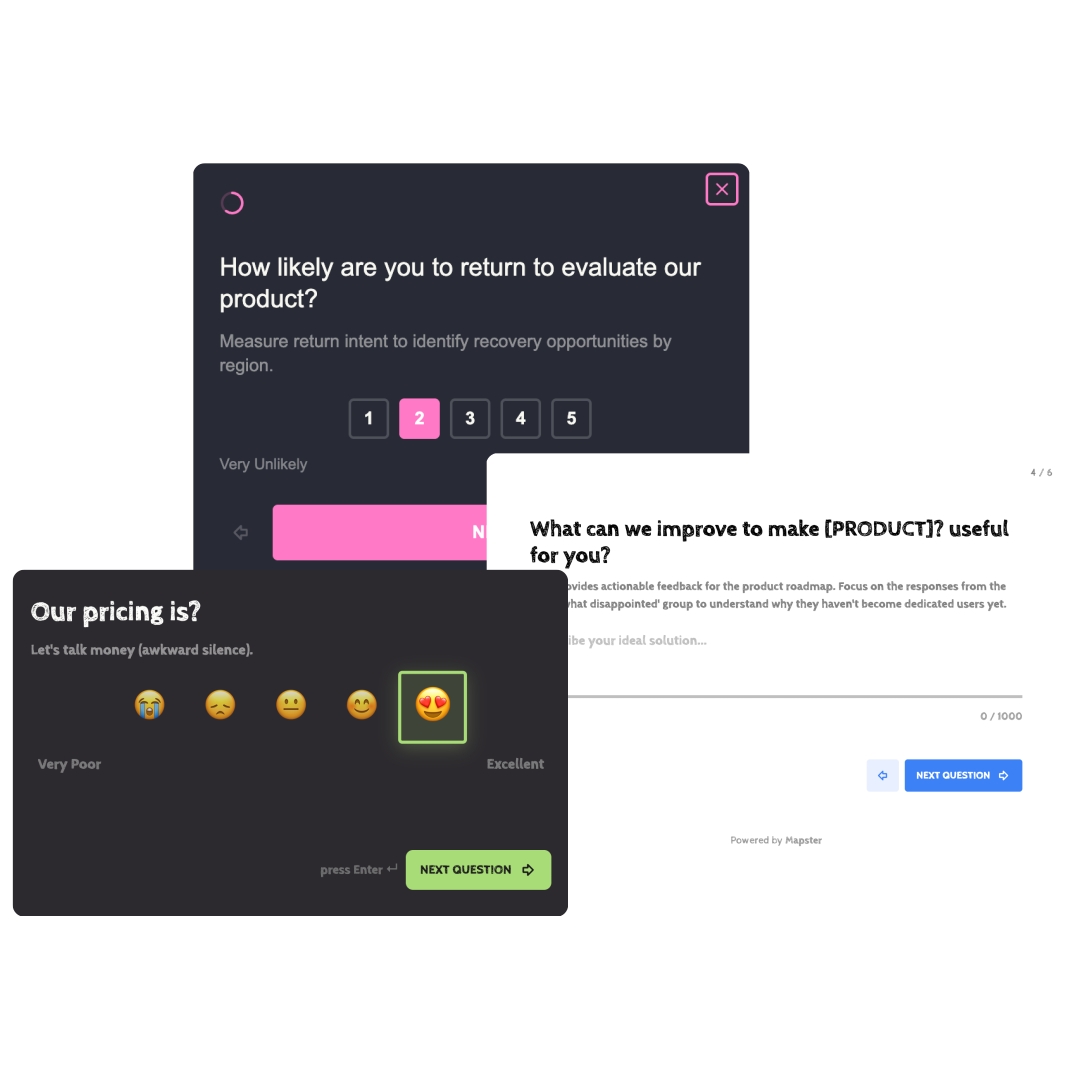
Definition
What is a Likert scale?
A Likert scale (also called a Likert questionnaire or Likert-type scale) is a psychometric rating scale that measures attitudes or opinions by asking respondents how much they agree or disagree with a statement. Named after organizational psychologist Rensis Likert who developed it in 1932, it is the most widely used question format in survey research.
The classic format uses 5 labeled response options: Strongly Disagree, Disagree, Neutral, Agree, Strongly Agree. Each option is assigned a number (1-5) so responses can be averaged, tracked over time, and compared across segments. A Likert-type scale uses the same structure but may vary the labels or number of points - for example, a satisfaction scale (Very Dissatisfied to Very Satisfied) or a frequency scale (Never to Always).
Likert scales are the foundation of NPS, CSAT, and CES surveys. The difference is that NPS uses a 0-10 numeric scale, while classic Likert scales use labeled response points.
Likert Survey Examples
The same Likert structure applied to five different dimensions. Each survey scale measures a different kind of respondent opinion - pick the one that matches what you are trying to learn.
Agreement scale
"[Product] makes it easy to accomplish my goals."
Measure whether users agree with a statement about your product, process, or service.
Satisfaction scale
"How satisfied are you with your onboarding experience?"
Measure satisfaction with a specific interaction, feature, or experience. Used in CSAT surveys.
Frequency scale
"How often do you use [feature] to complete this task?"
Measure how often a behavior occurs. Useful for usage and behavioral segmentation.
Importance scale
"How important is [feature] to your workflow?"
Prioritize features, roadmap decisions, and support improvements by importance to users.
Likelihood scale
"How likely are you to recommend [Product] to a colleague?"
Measure intent to act - upgrade, refer, renew. The NPS question uses a variant of this.
Likert scale for likelihood
A likelihood Likert scale measures how probable a respondent considers an action - or how likely they are to take it. It is the standard format for referral intent, upgrade propensity, renewal likelihood, and feature adoption surveys.
5-point likelihood scale
Use for: customer feedback surveys, in-product surveys, and email surveys where simplicity matters. Well-benchmarked and easy to complete on mobile.
7-point likelihood scale
Use for: research where subtle differences in likelihood matter. Adds "Very Unlikely" and "Very Likely" for more granularity, at the cost of some completion rate.
Common likelihood label variants
Likelihood scale question examples
How likely are you to recommend [Product] to a colleague?
Likelihood scale (1–5)
How likely are you to upgrade to a higher plan in the next 3 months?
Likelihood scale (1–5)
How likely are you to continue using [Product] next year?
Likelihood scale (1–5)
How likely are you to try a new feature when we launch it?
Likelihood scale (1–5)
How likely are you to switch to a competitor in the next 6 months?
Likelihood scale (1–5)
How likely are you to recommend [Product] to your company as a company-wide tool?
Likelihood scale (1–5)
Likelihood scale vs NPS
NPS uses a 0–10 numeric likelihood scale - “How likely are you to recommend us to a friend or colleague?” It is technically a likelihood-scale question. The difference from a 5-point Likert likelihood scale is that NPS uses 11 numeric points (no labels in the middle) and has a specific scoring formula: Promoters (9–10) minus Detractors (0–6). Use a 5-point likelihood Likert scale when you want labeled anchors and a simpler analysis. Use NPS when you want the standardized benchmark and industry comparisons.
5-point vs 7-point Likert scale
Both are valid. The choice depends on how much nuance you need and who your respondents are.
5-point Likert scale
Simpler and faster to answer
Well-established benchmarks (CSAT, CES)
Higher completion rates
Best for business and SaaS surveys
Less granularity between positions
Use when: running customer satisfaction surveys, CSAT, CES, product feedback, or any survey where simplicity and benchmarkability matter.
7-point Likert scale
More granularity between positions
Better for academic and clinical research
Captures "somewhat" responses
Harder to complete on mobile
Fewer established benchmarks
Use when: doing academic research, measuring subtle attitude differences, or when respondents are motivated enough to distinguish between 7 positions.
3-point Likert scale
Use when: completion rate is critical, respondents are on mobile, or the question is simple enough that three positions captures the full range of opinion. Loses granularity compared to a 5-point scale - avoid it when you need to track subtle trends over time or compare across segments.
Quick rule: Use a 5-point scale for customer and product surveys. Use a 7-point scale for academic or clinical research. Use a 3-point scale only when maximum simplicity is required. Never mix scales within the same survey for the same metric.
30+ sample Likert scale questions
Ready-to-use Likert survey questions organized by use case. Replace [Product] and [feature] with your own.
Customer satisfaction (CSAT) Likert questions
How satisfied are you with [Product] overall?
Satisfaction (1–5)
How satisfied are you with the support you received?
Satisfaction (1–5)
How satisfied are you with your onboarding experience?
Satisfaction (1–5)
How satisfied are you with the value you receive for the price you pay?
Satisfaction (1–5)
How satisfied are you with how often we release new features?
Satisfaction (1–5)
Product feedback Likert questions
[Product] makes it easy to accomplish my goals.
Agreement (1–5)
[Product] is easy to use.
Agreement (1–5)
[Product] integrates well with the other tools I use.
Agreement (1–5)
[Product] has all the features I need.
Agreement (1–5)
[Product] has improved since I first started using it.
Agreement (1–5)
I would be disappointed if I could no longer use [Product].
Agreement (1–5)
Feature prioritization Likert questions
How important is [feature] to your daily workflow?
Importance (1–5)
How important is it that [Product] integrates with [tool]?
Importance (1–5)
How important is mobile access to how you use [Product]?
Importance (1–5)
How important is real-time reporting to your team?
Importance (1–5)
How important is team collaboration in your workflow?
Importance (1–5)
Usage and behavior Likert questions
How often do you log in to [Product]?
Frequency (1–5)
How often do you use [feature] to complete [task]?
Frequency (1–5)
How often does [Product] replace a manual process for you?
Frequency (1–5)
How often do you share [Product] output with stakeholders?
Frequency (1–5)
Loyalty and referral Likert questions
How likely are you to recommend [Product] to a colleague?
Likelihood (1–5)
How likely are you to upgrade to a higher plan in the next 3 months?
Likelihood (1–5)
How likely are you to continue using [Product] next year?
Likelihood (1–5)
How likely are you to try a new feature when we launch it?
Likelihood (1–5)
Ease and effort Likert questions
It was easy to get started with [Product].
Agreement (1–5)
How easy was it to complete [specific task]?
Agreement (1–5)
Finding help and documentation is easy when I need it.
Agreement (1–5)
How easy is it to get value from [Product] without contacting support?
Agreement (1–5)
Likert scale best practices
Always label both endpoints
Never leave respondents guessing whether 1 is good or bad. Label at minimum the two endpoints and the midpoint. Unlabeled scales produce unreliable data.
Use odd-numbered scales
5-point and 7-point scales include a neutral midpoint, which is valid data. Even-numbered scales (4-point, 6-point) force a positive or negative response - useful only when you want to eliminate fence-sitting.
Keep the scale direction consistent
Always run high agreement on the right (or always on the left). Switching direction between questions causes straight-lining errors where respondents click the same position for every question.
Follow with an open-text question
A Likert question tells you the score. An open-text follow-up tells you why. "What is the main reason for your rating?" after a Likert question doubles the actionability of the data.
Limit to one topic per question
Avoid double-barreled questions: "The product is easy to use and well-priced." If a respondent disagrees with one but not the other, the data is meaningless. One idea per question.
Segment results by user attribute
A Likert mean of 3.8 across all users hides that enterprise users score 2.1 and free users score 4.6. Segment every Likert result by plan, role, and cohort to find the signal inside the average.
Likert scale survey templates
Three free Likert scale templates you can copy directly. Each template includes questions, scale format, and response labels replace [Product] and [feature] with your own.
CSAT
Customer satisfaction Likert scale template
How satisfied are you with [Product] overall?
Satisfaction (1–5)
[Product] meets my needs.
Agreement (1–5)
How satisfied are you with the support you received?
Satisfaction (1–5)
How likely are you to recommend [Product] to a colleague?
Likelihood (1–5)
Product feedback
Product feedback Likert scale template
[Product] is easy to use.
Agreement (1–5)
[Product] has all the features I need.
Agreement (1–5)
I would be disappointed if I could no longer use [Product].
Agreement (1–5)
How often do you use [Product] to complete your work?
Frequency (1–5)
Feature feedback
Feature feedback Likert scale template
How easy was [feature] to use?
Satisfaction (1–5)
[Feature] helps me complete [task] more efficiently.
Agreement (1–5)
How important is [feature] to your workflow?
Importance (1–5)
What would you improve about [feature]?
Open text
Or launch a pre-built Likert questionnaire template in Mapster:
Satisfaction scale
Customer Satisfaction (CSAT)
Satisfaction-scale Likert questions measuring experience after support, onboarding, or feature use.
Use templateAgreement + satisfaction
Customer Feedback Survey
Agreement and satisfaction Likert questions covering product value, ease of use, and loyalty signals.
Use templateLikelihood scale
NPS Survey
Likelihood-scale Likert question (0-10) plus open-text follow-ups to understand the score.
Use templateFrequently Asked Questions
Build Likert scale surveys that link every response to a real user
Use any Likert format above in Mapster. Every response is linked to the user who gave it - segment by plan, role, or cohort automatically.
Build a Likert Survey FreeNo credit card required